Since our friend was on vacation the past week, we were able to watch over their backyard chickens. M was in charge of feeding and caring for them - in exchange for fresh organic eggs! If you’ve never tried fresh organic backyard chicken eggs, you are missing out.
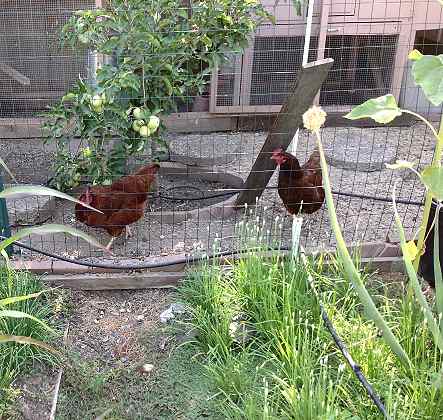
These hens are very friendly. But they do make lots of noise in the morning after they finish laying their eggs. I am surprised none of the neighbors have made complaints. I guess giving them free fresh eggs would change their mind.
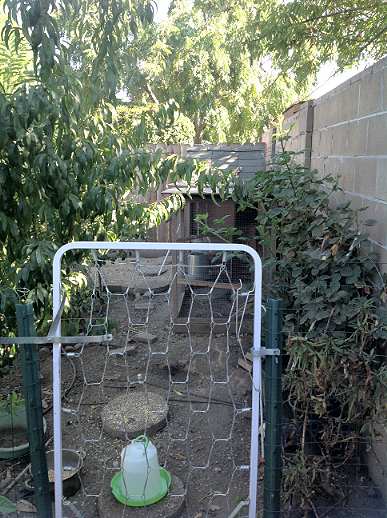
Entrance to the hen house.
It seem most suburban cities in California allow backyard chickens, just no rooster. Roosters are super noisy and don’t just croak to greet the sunrise, but all day and whenever they feel like it.
We had a pet chicken once, her name was . By her 3rd year she was retired and couldn’t lay anymore eggs. She lived to be 7 years old and died of natural causes last summer.
Unlike our friend’s backyard chicken, she didn’t have a pretty chicken coup, but she had a sleeping perch. She would always follow us around, especially my mom. And she she would come running if we called out her name. Who knew chickens had so much personality!
What Eliza enjoyed the most was roaming freely in the backyard and enjoying her life as a cage free chicken. She was a great addition to mom’s backyard garden because she would eat all the bugs like slugs and spiders. I truly miss having a pet chicken, but I don’t think I can have another one anytime soon.
According to Mother Earth News, compare to grocery store eggs, these backyard chicken eggs contain 2-3x’s more omega-3 fatty acids and 1/3 the cholesterol of factory-farmed eggs. I think that is great news for egg lovers.
Photos taken with iPhone, Campbell, California
I made a small batch of goat milk soap a few weeks ago…now they are ready for use. This one is made using all vegetable oil include rice bran, which is one of my favorite oils to use in soap making.
As for the scent, I prefer to use only essential oils (neroli and bergamont) since it has many skin healing benefits as well.
Goat milk itself makes for a great skin conditioning soap. Adding mineral rich Dead Sea mud also helps with detoxifying the skin. The mud contains minerals such as potassium, magnesium, sodium, bromine and calcium. And when applied to the skin it helps to detoxify and improve circulation.
I also included a little bit of Dead Sea salt as it’s proven to help with clear up skin problems. I guess I can say this is one healthy skin soap.
Rambutans used to be a rarity here in the U.S., but they can now be found in many Asian supermarkets or some farmer’s market. Before there was fresh ramutans, the best version were usually found canned. And with all the syrup they put in, it’s just takes away the unique taste and possible health benefits of this tropical fruit.
For those not familiar with rambutans it might look a bit out of this world. With the spikes and all, but don’t worry the spikes are harmless, very soft and flexible. Peeling the fruit can be tricky, but possible with your fingers or a knife. Just make sure you slice around the skin and don’t get to the flesh or seeds.
The taste is sweet with a bit of tartness. And if you’ve tasted lychee or longan, these are not so different.
Thailand is the largest producer of rambutan, but it is commonly found in other South East Asian countries as well. Even Australia has found success with marketing rambutan. It’s always exciting for me to find tropical and unique fruits have gained some popularity now.
Red lake near Emerald Bay, Lake Tahoe
Here is a peaceful and calm lake located at the Eldorado National forest in California. This photo  was taken with my little Fuji camera. These roads (highway 88-89) are best traveled during autumn when the leaves turn red, orange and yellow. The beauty of autumn will amaze you. Make sure to travel on Hwy 89 all the way to Emerald bay. Note: Click photo to enlarge.
From California Dept of Fish and Wildlife:
“The vegetation surrounding Red Lake is characteristic of red-fir and lodgepole-fir forest. Open slopes are dominated by sagebrush with bitterbrush and serviceberry. Forestdale Creek and the other drainages around Red Lake are lined with willows and aspen groves.
Common wildlife species include deer, coyote, jackrabbit, quail, flicker, warblers, red-tailed hawk, golden eagle, golden-mantled ground squirrel, marmot, and beaver.”
Access: The Wildlife Area can be accessed on both the north and east sides of Red Lake. The north entrance is located on State Highway 88, one mile east of Carson Pass. To enter on the east side, take Blue Lakes Road from Highway 88 to Red Vista Road.
I think it’s time to head to the beach and go fly a kite now.
“In summer I can taste the salt in the sea
There’s a kite blowing out of control on a breeze” -
I didn’t plan on growing any climbing spinach this year since I wasn’t too impressed with them. Well it turns out it wasn’t the plant to blame, but my lack of gardening skills.
Why do I say this? It’s because when the climbing spinach ended up growing on their own in mom’s backyard garden they all looked great! Of course it’s because she takes good care of her garden by fixing the soil, pest control and watering her plants daily.
Here is a perfect heart shaped climbing spinach vine leaf. The best climbing spinach grew out of the potted Mexican lime tree. It produced some of the biggest spinach leaves I’ve ever seen. The bigger leaves were the size of my hand, but those ended up in my salad.
And it made for a great summer salad that was crisp and cooling. All I did was sliced up the veggies and tossed it with rice bran oil, apple cider vinegar, honey and along with some tangy plums, cool iceberg lettuces, plus garden cherry tomatoes.
Here’s one that volunteer to grow along with Thai Basil. Theses guys like to climb, so best to grow them along fences or trellis. This one is just climbing up a small bamboo stick. Note, in the back row are mom’s super hot chili peppers. She has grown them in pots every year and they produce lots of peppers. Almost too hot and spicy for my taste buds!
Lina Hanson has recently launched the “Global Body Serum”. It’s 100% natural and made with some of the best oils for all skin type. Key ingredients include rice bran oil, avocado oil, Camellia seed oil, Grapefruit oil, Vanilla and Yuzu.
These combination of oils are full of skin nourishing vitamins that will keep your skin healthy and hydrated all day. And the scent is wonderful! Nothing overpowering or artificial here. I especially love the citrus scent of grapefruit and Yuzu, then mixed with sweet vanilla.
This is the sample I received and have been using for a few weeks. It soaks in nicely and my skin just loved it. Lina Hanson Global Body Serum comes in 100 ml (3.4 fl oz) dark glass pump bottle.
Another great thing about Lina Hanson is that the company uses ingredients that are harvested by women’s cooperatives and farmers worldwide. It’s one way the company is helping promote women’s economic growth and give them a sense of empowerment.
I happened to be at UC Davis recently and came upon this garden patch. There were all kinds of neat plants, fruit trees, and flowers. One of the fruit tree that caught my eye was the cornelian cherry.
The tree itself had such pretty green leaves and the fruit hanging from it reminded me of gem stones. But not to be confuse with carnelian gemstones.
One of the neatest thing about using cornelian cherry as landscaping is because they can be planted in partly shady areas under large trees. And it only takes 2-3 years for them to bear fruit.
When ripen, the fruit looks like bright red coffee beans but shaped like olives. And the fruit itself is tart and tasty. The taste also reminded me of cranberries. If I had baskets full of cornelian cherries, I would love to turn them into jam.
I had other appointments that day so I didn’t get to spend much time at the garden. But it turned out that the garden I stumbled upon at UC Davis was part of “The Arboretum gardens“. The last time I visited this campus was almost a decade ago and it did not look this pretty. So next time I am in the area again, I will definitely pack a few sandwiches and have a picnic at the garden. Which happens to be open 24 hours a day, every day of the year, and there is no charge for admission.
I just ran out of my last bottle of seabuckthorn facial cream made by Sibu Beauty. Not that there was anything wrong with Sibu’s cream, it’s just that I wanted to give a different brand a try. So I picked up a bottle of seabuckthorn facial cream made by Seabuck Wonders. To my surprise, Seabuck Wonders has been around for almost 20 years and I’ve barely heard of them.
This cream goes on smoothly and my skin just soaks it up. It’s lightly scented with orange essential oil and not overpowering at all. I normally use this facial cream at night because it doesn’t have much SPF protection, maybe SPF protection of 4-5. But if I were to use it in the daytime, I would normally apply mineral power with natural SPF.
Here’s a list of some of the benefits of the cream (as mentioned by SeabuckWonders):
Enhances skin tone and texture
Made with certified organic Sea Buckthorn
Vegan; Non-GMO
Paraben-free; Cruelty-free
Naturally scented with essential orange oil
For all skin types
Besides all the beauty benefits, the company also believes in sustainable farming. As noted by Seabuck Wonders;
“The berries are harvested once they have reached maturity and allowed to re-fruit the following year. Only the minimum number of branches and leaves necessary are removed, leaving the majority of the plant intact, to continue to grow for the next season’s harvest. These practices allow for healthy trees and a sustainable source of income for the farmers.” That’s what I call good farming and business practice.
At the moment Seabuck Wonders is having a sale on their berry oil, facial cream, and body lotion set at their website. Enter coupon code SUN50 fro 50% good until July 7, 2013.
Btw, I love seabuckthorn that much and even have my own plant, which is now 4 years old. It’s gotten a bit bigger now, but no seeds yet.
I haven’t been paying attention to singers from Australia since Kasey Chambers. So I’m always happy to come across something new. Well, at least it’s new to me.
Kate has a such a beautiful and unique voice. This song is both relevant and honest to me. Check out more of Kate’s songs .
The Last Day on Earth was first released 2009 in Australia. Kate Miller-Heidke is a singer-songwriter from Brisbane, Australia. Although classically trained, she has followed a career in alternative pop music. She is signed to Sony Australia. - source Wikipedia.
Looking forward to getting her CD soon.